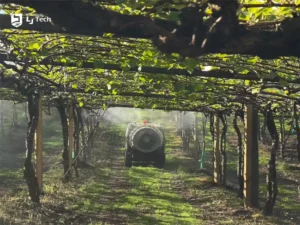
Precision Variable-Rate Spraying for Autonomous Orchard Robots — Reduce Pesticide Use, Cut Costs, and Improve Fruit Quality
Introduction
For commercial fruit growers worldwide, pesticide application remains one of the largest recurring input costs every growing season. Traditional constant-rate sprayers treat every tree and every canopy section exactly the same, regardless of actual foliage density, pest pressure, or tree size. The result is significant chemical waste, higher operating costs, and inconsistent spray results. Precision variable-rate spraying, combined with autonomous orchard robot platforms, is changing this picture. By sensing canopy structure in real time and adjusting spray output accordingly, these systems deliver chemical only where and when it is needed. This article explains how the technology works, what savings growers can realistically expect, and how it supports better fruit quality and more consistent orchard management.
What Is Precision Variable-Rate Spraying in Orchards?
Precision variable-rate spraying means the robot automatically adjusts spray output based on real-time canopy sensing data. Instead of spraying a fixed volume per hectare across the entire orchard, the system detects tree presence, canopy volume, and foliage density, then modulates output on the fly.
Modern autonomous orchard sprayers, such as the LJ Tech S500Pro and S1000, are equipped with canopy sensing capabilities. As the robot travels down a tree row, sensors scan the surrounding canopy and measure foliage conditions in real time. The onboard control system then adjusts spray output to match the detected canopy characteristics, delivering more chemical where foliage is dense and less where it is sparse.
However, sensing accuracy is not unlimited: low-light conditions, strong glare, rain, fog, dust, and strong wind can all reduce the reliability of canopy detection, so practical operation still depends on suitable weather windows and system-level sensor fusion.
Constant-Rate vs. Variable-Rate — The Core Difference
A conventional constant-rate sprayer runs all nozzles at a fixed flow rate from the beginning to the end of a row. It sprays equally through dense canopies, young trees with sparse foliage, and empty gaps between trees. A variable-rate system, by contrast, reduces or shuts off flow in low-density areas and increases output only where canopy volume demands it. Over a full season, this difference compounds into substantial chemical and water savings.

Realistic Pesticide and Cost Savings for Commercial Orchards
The economic case for precision variable-rate spraying is built on three layers: reduced chemical consumption, lower water and fuel use, and improved spray efficacy that reduces re-spraying needs.
Chemical Reduction — What the Data Typically Shows
In commercial orchard trials, variable-rate canopy sensing systems commonly reduce total pesticide use by 20% to 40% compared with constant-rate spraying, depending on crop type, tree age uniformity, and canopy density variation. Young orchards with uneven tree sizes, or mixed-variety blocks, tend to see the highest savings because constant-rate systems massively over-spray smaller trees. Even in mature, uniform orchards, savings of 15% to 25% are regularly reported due to natural canopy gaps and density variation.
Beyond Chemicals — Water, Fuel, and Labour Efficiency
Lower spray volume means less water carried and consumed per mission, which directly extends the robot’s effective working time between refills. Reduced pump and fan load also lowers fuel consumption per hectare. Because autonomous robots such as the S1000 can operate continuously without driver fatigue, and variable-rate logic reduces refill frequency, a single supervisor can cover more hectares per day. For farms running multi-robot fleets through the Smart Farm Platform, these efficiency gains scale across the entire operation.
Improved Efficacy Reduces Re-Spray Costs
Over-spraying does not just waste chemical — it can also cause run-off, leaf burn, and uneven deposition. Variable-rate systems deliver a more consistent droplet density across the canopy, improving target coverage and reducing the need for follow-up applications when pest pressure spikes. Fewer spray passes per season means lower total operating cost and less compaction on orchard soil.

Better Fruit Quality and Higher Marketable Yield — The Hidden Benefit of Variable-Rate Spraying
Reduced chemical use is the most discussed benefit of precision spraying, but for commercial growers, fruit quality and marketable yield often matter even more to the bottom line. Over-spraying causes leaf burn, fruit russeting, and uneven residue on fruit surfaces, all of which can downgrade fruit grade and reduce the percentage of produce that can be sold at premium prices. Variable-rate spraying delivers a more controlled and uniform deposition across the canopy, which supports cleaner fruit surfaces and more consistent tree health. Results vary by crop variety, climate, and overall orchard management practices.
Reducing Phytotoxicity and Fruit Surface Damage
When constant-rate sprayers push excessive liquid onto dense canopies, droplets accumulate and run down branches and fruit. This run-off not only wastes chemical but also increases the risk of phytotoxicity — visible leaf burn, necrotic spots, and fruit surface damage that make produce less suitable for fresh-market grading. Variable-rate systems modulate output to match canopy absorption capacity, keeping droplet deposition within a safer and more effective range. In practical terms, this can mean fewer rejected fruits at harvest time and a higher share of produce meeting top-grade quality standards.
More Consistent Canopy Coverage for Stable Fruit Quality
Pest and disease pressure is rarely uniform across an orchard. Shaded inner canopy sections, dense foliage zones, and the transition areas between sun and shade each have different protection needs. Constant-rate spraying tends to under-protect inner canopy zones while over-saturating outer surfaces. Variable-rate sensing adjusts output per canopy zone, helping hard-to-reach inner foliage receive adequate coverage without over-saturating the outer canopy. The result can be more consistent pest and disease control throughout the tree, which supports more uniform fruit size, colour, and ripening across the harvest — a factor valued by buyers who pay premium prices for batch consistency.

Is Precision Variable-Rate Spraying Right for Your Orchard?
While the benefits are clear, variable-rate spraying delivers the highest return in orchards with variable canopy structure — young trees, mixed varieties, uneven blocks, or wide row spacing. In perfectly uniform mature plantations, savings are more modest but still meaningful.
Precision variable-rate spraying is more than a cost-cutting feature — it is a strategic tool for modern orchard management. By pairing real-time canopy sensing with autonomous robot platforms, commercial growers can reduce pesticide input, lower per-hectare operating cost, improve spray efficacy, and support better fruit quality consistency.
If you are evaluating autonomous spraying solutions for your orchard and want to understand how variable-rate technology can perform on your specific blocks, contact our team for a tailored consultation and on-site demo arrangement.